Most lists of final year projects for CSE give you fifty titles and leave the hard part to you: deciding which one your team can finish, document and defend. This page covers 15 ideas. Each one states the first version to build, a sensible stack, the part that usually goes wrong, and a viva question you should expect.
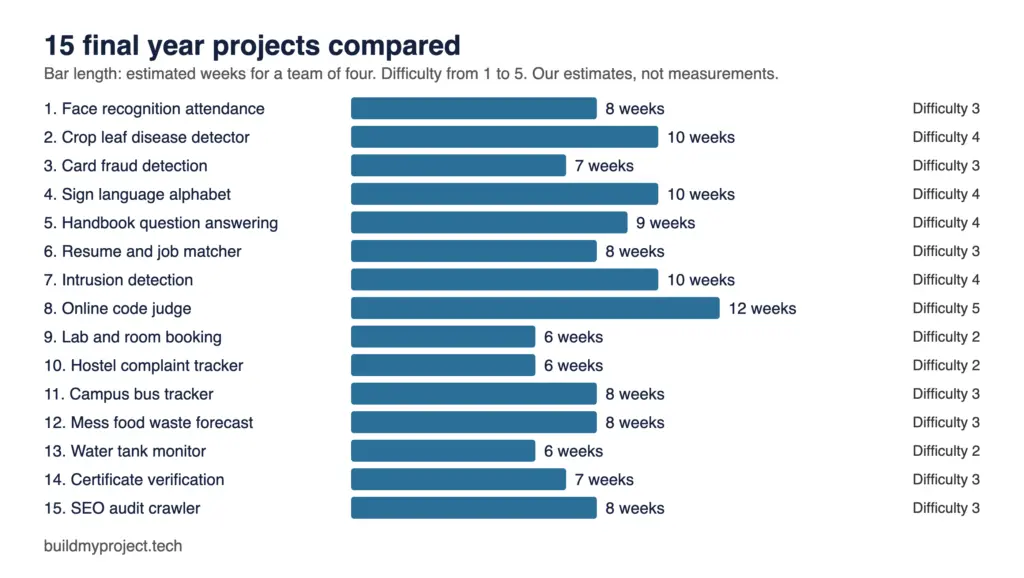
Two numbers appear next to every idea. Difficulty runs from 1 (mostly CRUD) to 5 (research-flavoured). Weeks is our estimate for a team of four working part time. Neither number is measured; use them to compare ideas, then adjust for what your team already knows.
How to choose a final year project you can finish
Run each idea through four checks before you write the synopsis.
- Can you get the data or hardware this week? A model without a dataset, or an IoT idea without a board, is still a wish.
- Can you describe the first working version in one sentence? If that sentence needs the word “and” three times, cut it down.
- Can you measure whether it works? Accuracy, response time, cost per request or minutes saved all count. “User friendly” does not.
- Can every member own a part? Examiners ask individuals, not teams.
If an idea fails one check, change the scope. If it fails two, drop it. Teams choosing a smaller semester project can use the same checks on our computer science project ideas page.
All 15 final year project ideas for CSE compared
| # | Project | Area | Difficulty | Weeks | Hardest part |
|---|---|---|---|---|---|
| 1 | Face recognition attendance | Computer vision | 3 | 8 | Lighting, look-alikes, consent |
| 2 | Crop leaf disease detector | Deep learning | 4 | 10 | Field photos differ from lab photos |
| 3 | Card fraud detection | Machine learning | 3 | 7 | Very few fraud examples |
| 4 | Sign language alphabet reader | Computer vision | 4 | 10 | Similar hand shapes |
| 5 | College handbook question answering | NLP | 4 | 9 | Wrong but confident answers |
| 6 | Resume and job matcher | NLP | 3 | 8 | Bias in scoring |
| 7 | Intrusion detection dashboard | Security | 4 | 10 | False alarms |
| 8 | Online code judge | Systems | 5 | 12 | Running untrusted code |
| 9 | Lab and room booking | Web | 2 | 6 | Double bookings |
| 10 | Hostel complaint tracker | Web | 2 | 6 | Roles and escalation |
| 11 | Campus bus tracker | Mobile | 3 | 8 | GPS gaps, battery drain |
| 12 | Mess food waste forecast | Data | 3 | 8 | Short history |
| 13 | Water tank monitor | IoT | 2 | 6 | Sensor drift, Wi-Fi drops |
| 14 | Certificate verification | Security | 3 | 7 | Key handling |
| 15 | SEO audit crawler | Web, systems | 3 | 8 | Crawling politely |
Machine learning and vision projects
1. Face recognition attendance system
First version: register ten volunteers, detect faces from one webcam, match them and write the result to a database. Stack: Python, OpenCV, a pretrained face embedding model, SQLite. Where it goes wrong: poor light and people who look alike. Report the false match rate, not only accuracy. Face images are personal data, so collect written consent and delete the images after the demonstration. Viva question: how did you pick the match threshold?
2. Crop leaf disease detector
First version: classify three diseases of one crop. Stack: PyTorch, a small pretrained network, a phone-friendly web page. Where it goes wrong: the photos people take outdoors. In a well-known study the model reached 99.35% on its test set but only just above 31% accuracy on images taken under different conditions. Collect even 50 field photos and report both results. That comparison is a better chapter than another decimal place. Viva question: why did accuracy drop outdoors?
3. Credit card fraud detection
First version: train logistic regression and one tree model, then compare them. Stack: Python, scikit-learn, a FastAPI endpoint. Where it goes wrong: the popular public card fraud dataset has 492 frauds in 284,807 transactions, so a model that always answers “not fraud” is over 99.8% accurate and useless. Use a precision and recall curve instead. Viva question: which costs more here, a false alarm or a missed fraud?
4. Sign language alphabet reader
First version: recognise ten static letters from a webcam. Stack: MediaPipe hand landmarks and a small classifier. Working on 21 hand points instead of raw pixels needs far less data. Where it goes wrong: letters with nearly identical hand shapes, and testing on the same people you trained on. Keep at least two people out of training. Viva question: what happens with a signer the model has never seen?
5. College handbook question answering
First version: answer questions from one PDF and show the page each answer came from. Stack: Python, an embedding model, a vector index, any language model. Where it goes wrong: answers that sound right and are not. Write 40 test questions by hand, including ten the handbook cannot answer, and check that the system says “not found” for those. Viva question: how do you know it did not make that up?
6. Resume and job description matcher
First version: rank 30 resumes against one job description and show which skills matched. Stack: spaCy or sentence embeddings, Flask. Where it goes wrong: scores that change with a name, gender or college. Swap those details, score again and report the difference. Viva question: would you let this reject a candidate without a person checking?
Security and systems projects
7. Network intrusion detection dashboard
First version: classify recorded traffic and list alerts by severity. Stack: Python, scikit-learn, a small web dashboard. The University of New Brunswick publishes the CICIDS2017 intrusion detection dataset, which holds five days of labelled traffic with one attack-free day. Where it goes wrong: mixing records from the same attack into training and testing, which inflates the score. Split by day. Viva question: how many false alarms would an administrator see per hour?
8. Online code judge
First version: accept C++ and Python, run against hidden tests, return pass, fail or time-out. Stack: Node or Go, a job queue, Docker. Where it goes wrong: you are running strangers’ code. By default a container has no memory or CPU limit, so set container resource limits and disable networking before you accept a single submission. Viva question: what stops an infinite loop from taking the server down?
14. Certificate verification system
First version: sign each certificate and verify it from a QR code. Stack: any web framework, a standard digital signature library. Where it goes wrong: adding a blockchain because it sounds better. A college that issues its own certificates already is the trusted party, so a signature does the job. Explaining why you left blockchain out is a strong answer. Viva question: what happens if the signing key leaks?
15. SEO audit crawler
First version: crawl up to 200 pages of a site you own; report broken links, missing titles, duplicate descriptions and images without alt text. Stack: Python, an HTML parser, SQLite. Where it goes wrong: crawling too fast, or ignoring robots.txt. Before writing the report screen, look at how an agency describes its SEO and AI search visibility work, then decide which findings a site owner would pay attention to. Viva question: how do you avoid crawling the same page twice?
Web, mobile and IoT projects
9. Lab and room booking
First version: show free slots, book one, cancel one. Stack: React, Express, PostgreSQL. Where it goes wrong: two people booking the same slot at the same moment. Checking in application code is not enough; let the database refuse the overlap. Viva question: show me what happens when two requests arrive together.
10. Hostel complaint tracker
First version: file a complaint, assign it, close it. Stack: Django or Laravel. Where it goes wrong: every role can see everything. Draw a permissions table before coding and write a test for each row. Add automatic escalation after 48 hours if you have time. Viva question: can a student open another student’s complaint by changing the URL?
11. Campus bus tracker
First version: one driver’s phone sends its location and a web map shows it. Stack: Flutter or a web app, WebSockets. Where it goes wrong: battery drain and dead zones. Send a location only when the bus has moved, and show how old the last reading is. Viva question: what does the passenger see when the signal is lost?
12. Mess food waste forecast
First version: predict tomorrow’s plate count from past counts, weekday and holidays. Stack: Python, pandas, a simple regression. Where it goes wrong: beating nothing. Compare against “same as last week” first; if your model loses, say so and explain why. Viva question: what is your baseline?
13. Water tank level monitor
First version: an ESP32 reads one ultrasonic sensor and sends the level over MQTT, an IoT messaging standard. Stack: ESP32, an MQTT broker, a chart page. Where it goes wrong: readings that jump. Average several samples, reject impossible values and test by unplugging the router. Viva question: what does the system do when Wi-Fi returns?
A ten-week plan that leaves time for the report
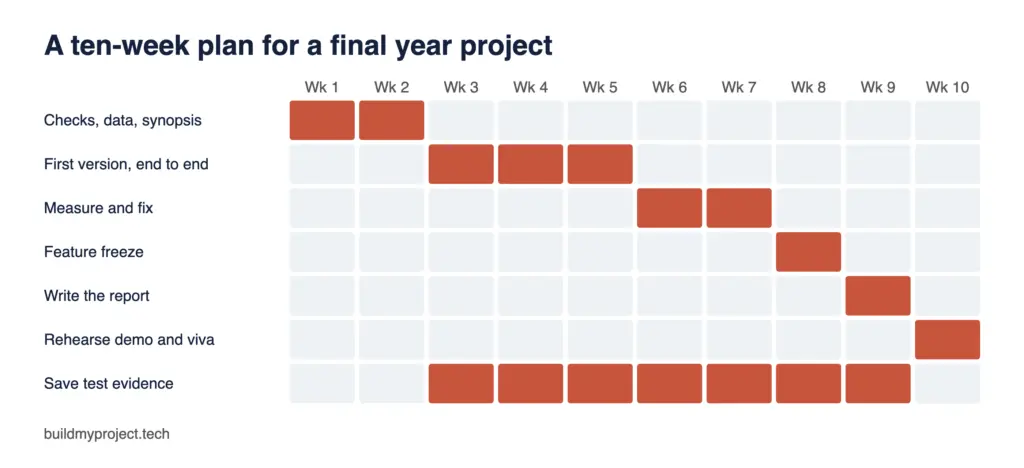
- Weeks 1–2: run the four checks, collect data or parts, write the synopsis.
- Weeks 3–5: build the first version end to end, even if it is ugly.
- Weeks 6–7: measure it, fix the worst problem, measure again.
- Week 8: freeze features. Nothing new after this.
- Week 9: write the report from your notes and test results.
- Week 10: rehearse the demonstration and the viva.
Start the report in week three by saving screenshots and test output as you go. Our mini project report format lists the chapters and what belongs in each, and the same order works for a major project.
What examiners look for in the viva
Prepare three answers as a team: the problem and who has it, one design decision you changed and why, and one limitation you measured. Then make sure each member can open the file they wrote and explain it line by line. If you used a library, a tutorial or an AI tool, say so before you are asked. Our viva preparation checklist covers the rest of the evening before.
Frequently asked questions
Which project is best for CSE final year?
The one that passes the four checks above for your team. If you want a starting point, lab booking (9) suits a web-focused team and fraud detection (3) suits a team that has done one machine learning course.
How many members should a final year project have?
Follow your department’s rule. The estimates on this page assume four people, so add time for a smaller team.
Can I use an existing GitHub project?
You can learn from one if its licence allows it and you credit it. You still need a part that is yours: a new dataset, a fixed weakness, or a measured comparison.
Do I need machine learning to score well?
No. A booking system with a proven answer to double bookings is easier to defend than a model nobody on the team can explain.